Last fact-checked: July 2026 · Reading time: ~10 minutes
By Teknix Elevators | Bangalore's Premier Elevator Company
Architects need a number to draw with today. Manufacturers can only give you the real number once a model is chosen. That gap is why home-lift space planning goes wrong, and this guide is built around it.
Everything below is a planning range — enough to block out space on a floor plan, decide where the shaft goes, and check whether your structure can take one. Before concrete is poured, those ranges get replaced by the GA (general arrangement) drawing for the model you've bought, the only dimensionally authoritative document in the project. Design with the ranges; build from the GA drawing.
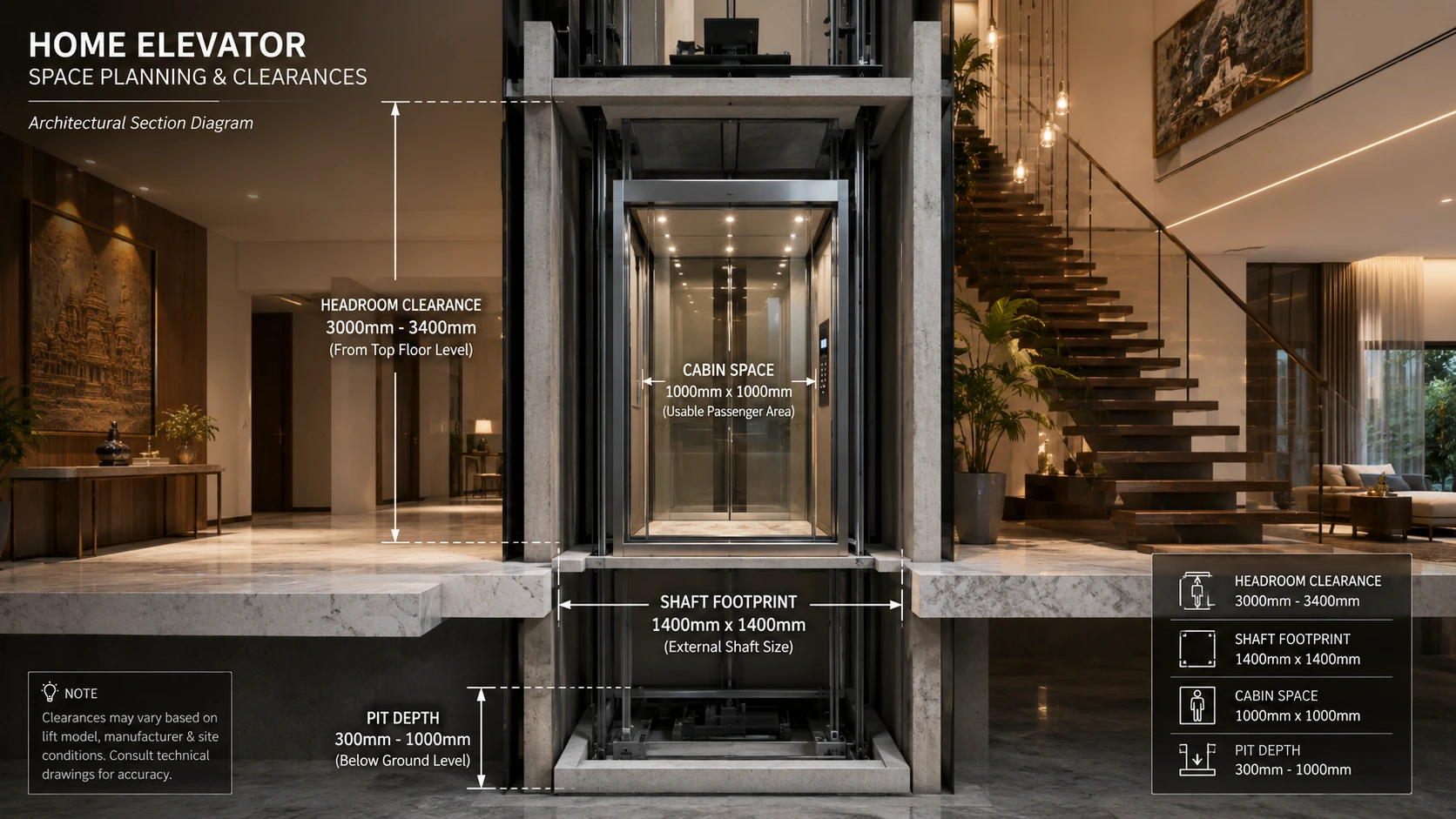
The short answer: for a 4 passenger lift size — a common planning configuration for a villa home lift — plan a 1000 × 1000 mm cabin inside a 1400 × 1400 mm clear shaft, with a rated load around 272 kg. Compact two-passenger systems fit a 1200 × 1200 mm shaft; wheelchair-accessible installations need a shaft of 1600 mm or more in width, for a cabin of 1100 × 1400 mm.
If you haven't worked out budget yet, our Home Elevator Cost in Bangalore (2026) guide covers pricing, civil work and approvals. This guide is its spatial companion.
Planning sizes by capacity
Rated loads follow the Indian convention of roughly 68 kg per passenger, so a "4-passenger" lift is typically rated 272 kg. Worth knowing, because capacity in kilograms — not passenger count — is what appears on quotes and compliance paperwork.
| Capacity | Typical rated load | Cabin (W × D) | Planning shaft footprint (W × D) | Clear door width | Suits |
|---|---|---|---|---|---|
| 2–3 passenger | 136–204 kg | 800 × 800 mm | 1200 × 1200 mm | 600–700 mm | Compact retrofits, tight duplexes |
| 4 passenger | ~272 kg | 1000 × 1000 mm | 1400 × 1400 mm | 700–800 mm | Common for villas (G+2/G+3) |
| 6 passenger | ~408 kg | 1100 × 1200 mm | 1500 × 1600 mm | 800–900 mm | Joint families, higher traffic |
| Wheelchair + attendant | 400–630 kg | 1100 × 1400 mm | 1600 × 1800–2000 mm | 900 mm | Accessibility, ageing in place |
These footprints assume a machine-room-less system with telescopic sliding doors. Two decisions shift them, both explained below: the drive type and the door configuration. Settle those early and the shaft dimension stops moving.
4 passenger lift size: a common villa configuration
This is a frequent starting point for villa projects, so it's worth setting out in one place.
- Rated load: approximately 272 kg (4 × 68 kg)
- Cabin: 1000 × 1000 mm internal
- Clear shaft: 1400 × 1400 mm with telescopic sliding doors on a machine-room-less system
- Clear door opening: 700–800 mm
- Cabin height: typically 2100–2400 mm
Shaft width moves with the door choice: around 1300 mm with manual swing doors, 1400 mm with telescopic doors, and about 1550 mm with centre-opening doors — same cabin in all three cases. Conventional (non-MRL) drives need more width again.
In the units architects and homeowners often think in: a 1400 × 1400 mm shaft is roughly 2 sq m, or about 21 sq ft of floor plate — and it consumes that area on every floor the lift serves, not just the ground floor.
Two caveats that matter more than the numbers. First, a 4 passenger lift is not automatically wheelchair-accessible: a 1000 × 1000 mm cabin with a 700 mm door is not a wheelchair-accessible configuration — the cabin is too shallow and the door too narrow, whatever the passenger rating says. Second, these are planning figures, not the numbers your structural engineer builds to.
Why the shaft is always bigger than the cabin
The shaft houses more than the cabin: guide rails, the counterweight on traction systems, cylinder brackets and mounting hardware on hydraulic ones, door operators, and the clearances a technician needs to work safely. How much extra depends on the drive — compact gearless MRL systems typically add roughly 250–400 mm to cabin width, while conventional traction arrangements typically add 400–600 mm. Treat those as typical industry allowances rather than fixed rules.
That range is why two suppliers quoting the same cabin can ask for shafts 200 mm apart: it's a question about the machine, not the passenger count. The practical consequence for a new build is scheduling — decide the drive technology before the structural drawings are finalised. Our hydraulic vs. gearless traction comparison walks through that choice.
How door type changes your shaft width
This is the planning trap almost nobody warns about. Cabin size stays identical, door mechanism changes, shaft width moves by up to 250 mm — enough to redraw a room boundary.
Manual swing doors save the most space. The landing door swings outward into the room like a normal door, so no sliding panels need storing inside the shaft. For a 4-passenger cabin, this can bring the shaft down to around 1300 mm wide. The trade-off is convenience and a less premium feel.
Automatic telescopic doors slide two panels that stack to one side. That side needs a pocket inside the shaft. For a 4-passenger cabin, plan around 1400 mm — the baseline in the table above, and the most common residential choice.
Automatic centre-opening doors are the premium option: panels part from the centre and retract both ways, so both sides need pockets. Plan around 1550 mm for the same 4-passenger cabin.
Same cabin, three shafts, 250 mm apart. If space is tight, door type is the cheapest lever you have.
Where can a home lift go?
Once you know the footprint, the next question is where it lands. Three rules eliminate most bad options before you measure anything: the location must be vertically consistent, with the same footprint free on every floor served; it should sit near circulation, so nobody walks through a bedroom to reach it; and for retrofits, the closer to an external wall, the simpler the structural and access work tends to be.
The stairwell void. The open space at the centre of a staircase is usually unused on every floor, which makes it the most common retrofit location. Feasibility turns on whether the void's clear dimensions take the shaft you need, whether the staircase geometry — straight, dog-leg, spiral — leaves a usable rectangle, and whether the landings can accommodate a door opening. Measure the void at its narrowest point, not its widest.
An internal corner, unused closet, or space beside the staircase. These work when the same footprint is genuinely free on every floor — rarer than homeowners expect once wardrobes and bathrooms are mapped across levels — and they cost floor area on each level.
Externally, against an outside wall. A self-supporting shaft with door openings cut through at each level is a well-established retrofit approach that can reduce interior disruption, subject to approvals and site conditions — no interior floor area is lost, and much of the construction happens outside the living space. Watch weather sealing at the openings, the foundation for the shaft base, and whether the structure affects setback or coverage under your building approval. Glass shafts are popular here for how they look against the elevation.
A self-supporting structure carries the lift's loads into its own base and foundation rather than into your walls — but "self-supporting" means it doesn't need your walls, not that it doesn't need engineering. Foundation design and structural checks still apply.
Pit and headroom: the vertical dimensions
Horizontal footprint gets the attention; vertical clearance is what forces expensive redesigns late in a project.
The pit is the recess below the lowest served floor that houses buffers and safety gear. Requirements vary widely — from a few hundred millimetres up to a metre or more on conventional configurations. Some modern hydraulic systems eliminate it entirely: our own Hydratek range is a pitless design, which is why it works in retrofits where excavating below an existing slab would mean touching the footings.
Headroom is the clear height from the top landing's finished floor to the underside of the shaft ceiling. Traction systems need enough of it to house the drive at the top of the shaft; hydraulic systems are generally more forgiving. But the old rule of thumb that hydraulic needs 2600 mm and traction needs 3400 mm no longer holds reliably — compact MRL designs have narrowed that gap considerably. Machine-room-less hydraulic designs also avoid a terrace extension altogether.
For both, get the figures the quoted model actually needs in writing before your architect commits to slab levels. This is where "we'll sort the details later" turns into breaking concrete.
Accessibility: the three numbers that change everything
If a wheelchair user will use the lift — now or in fifteen years — passenger labels stop being useful and three dimensions govern the design: a 1100 × 1400 mm cabin (the Type 2 benchmark under EN 81-70), a 900 mm clear door opening, and a 1500 × 1500 mm flat clear landing in front of the doors on every floor. That last one sits outside the shaft, so it never appears in a lift quote — and it's the one most often missed.
One interaction to note here, because it cuts across the door section above: accessibility compliance requires automatic power-operated sliding doors, so the manual swing doors that save shaft width are not available in an accessible configuration.
Three planning mistakes worth avoiding
Designing the bare-minimum shaft. Stepping a shaft from 1200 mm square to 1400 mm square takes the cabin from roughly 800 × 800 to 1000 × 1000 — about 55% more cabin floor area for 100 mm of extra structure on each side. During new construction that's a drawing change. After the slab is poured, it's a demolition decision.
Forgetting wall thickness. A 1400 × 1400 mm internal clear shaft needs walls around it. Confirm your architect has carried the wall or frame thickness into the room boundaries — clear internal dimension and overall footprint are different numbers, and quotes always cite the former.
Planning for today's household only. Adding a floor or an accessibility requirement at design stage is a drawing change; adding it after construction is a construction project. If a future floor or a future wheelchair need is plausible, size for it now.
What to ask your supplier for
Before your architect finalises drawings, get these in writing:
- GA drawing for the quoted model — clear internal shaft dimensions, cabin dimensions, pit depth, headroom, clear door width, cabin height
- Structural load data — the vertical and lateral forces guide rails and buffers transfer into your walls and pit floor, which your structural engineer needs
- True clear shaft layout — confirmation that no column, beam offset or plaster finish intrudes on the dimensions quoted
- Electrical requirements — voltage, phase, connected load in kW, earthing, and whether your supply needs upgrading; don't assume single- or three-phase
- Applicable standards and compliance documents — ask which current BIS standards the specific quoted model is certified against, not "BIS certified" in the abstract, and request the compliance documentation and type-test certificates for safety components. India's lift standards have been consolidating into the IS 17900 series while older codes remain in circulation, so if a quote cites an older code it's worth asking which version the model was certified to.
- Accessibility confirmation if relevant — cabin and clear-door dimensions stated against your requirement, not inferred from passenger count
A supplier who provides these quickly has done residential coordination before. One who offers dimensions without a drawing is asking you to pour concrete around an assumption.
Approvals are a separate matter from standards: Karnataka requires erection permission before installation and a licence before use, with a registered installer. The approvals section of our cost guide covers that process.
Getting the dimensions right for your home
Space planning decides a home-lift project months before anyone installs anything.
Teknix manufactures both hydraulic and gearless traction home lifts in Bangalore, so our spatial recommendation starts from your structure rather than one product's requirements. Our hydraulic range installs machine-room-less and pitless, often what makes a retrofit possible at all — see Hydratek →. Our residential gearless line is built for planned villa construction, with cabin configurations specifiable for wheelchair access — see Villa Matek →. We provide GA drawings, structural load data and architectural coordination as part of project planning, including site-readiness assessment for retrofits.
Book a site assessment in Bangalore →
Frequently Asked Questions
What is the size of a 4 passenger lift?
A 4 passenger lift is typically rated around 272 kg, with an internal cabin of about 1000 × 1000 mm, a cabin height of 2100–2400 mm, and a clear door opening of 700–800 mm. That cabin gives roughly 1 sq m of usable floor — comfortable for four adults at Indian rated loads, though not a wheelchair-accessible configuration.
What shaft size do I need for a 4-passenger home lift?
Plan 1400 × 1400 mm as a working figure — about 21 sq ft of floor plate, consumed on every floor the lift serves. Door type and drive type both move it: swing doors reduce it by roughly 100 mm, centre-opening doors add about 150 mm, and conventional non-MRL drives need more width than compact gearless systems.
What is the minimum space required for a home elevator?
Compact 2–3 passenger systems can work in a shaft footprint around 1200 × 1200 mm, and some ultra-compact models go smaller with swing doors. Vertically, requirements range from pitless designs needing no excavation at all up to a metre of pit on conventional configurations, with headroom varying by drive type. Minimums are model-specific — treat published figures as a feasibility check, not a specification.
How much space does a wheelchair-accessible home lift need?
Plan a 1100 × 1400 mm cabin (the EN 81-70 Type 2 benchmark for a wheelchair user with an accompanying person), a clear door width of 900 mm, and a 1500 × 1500 mm flat clear landing area in front of the doors on every floor. The landing space is most often missed, because it isn't part of the lift. Confirm which accessibility standards apply to your model with your supplier.
Do hydraulic lifts need less space than traction lifts?
Vertically, usually — shallower pits or none at all, and more forgiving headroom. Horizontally, they need broadly similar shaft widths, because guide rails and cylinder hardware occupy the kind of room a counterweight does. Hydraulic buys vertical flexibility, not a smaller floor footprint.
How deep does the lift pit need to be?
Anywhere from nothing to over a metre, depending on the system. Pitless hydraulic designs remove the question entirely; conventional systems need depth for buffers and safety gear. Since the pit is the lowest point in the house, whatever depth you end up with needs a proper waterproofing design — the cost guide covers why.
Why is the opening in the slab a different size from the shaft?
Because they measure different things. The clear shaft dimension is the finished internal space the lift occupies; the slab opening (sometimes called the hole-through-floor dimension) is the structural void formed between floors. The two can differ, and by how much depends on the wall or frame construction, finishes and fixing tolerances — there's no reliable generic rule. Obtain both figures from the supplier rather than deriving one from the other, and never work from the cabin dimension alone.
Do I need to strengthen my floors or walls?
Sometimes, and it depends on where the loads land. Guide rails transfer both vertical and lateral forces into the structure they're fixed to, and buffers transfer load into the pit floor. In a new build this is designed in. In a retrofit — especially into an older independent house — your structural engineer needs the supplier's structural load data to confirm whether existing walls, beams or footings can take it, or whether local strengthening is required. This is exactly why load data is on the checklist above rather than an afterthought.
Can I change the lift size after construction starts?
Cabin finishes and door styles, yes. Shaft dimensions, rarely without significant cost — once the shaft is formed, changing its clear internal size means structural work. This is the strongest argument for settling capacity, drive type and door configuration before the structural drawings are signed off.
Sources and standards referenced
- BIS published standards list, ETD 25 (Lifts, Escalators and Moving Walks committee) — for the current status of Indian lift standards, including the IS 17900 series and the home-lift code of practice IS 15259: BIS standards list
- EN 81-70 — European accessibility standard for lifts; source of the 1100 × 1400 mm Type 2 cabin benchmark with its 900 mm clear door opening (800 mm applies to the smaller Type 1 car, permitted in existing buildings), and of the requirement for automatic power-operated sliding doors
- BS 8300 — source of the 1500 × 1500 mm clear manoeuvring space at the lift entrance, which is building guidance rather than a lift-standard requirement
- Karnataka Lifts, Escalators and Passenger Conveyors Act and Rules — erection permission, licence to use, and registered-installer requirements; see our cost guide for the process
Standards in this field are actively being revised. Confirm current applicability for your model with your supplier before relying on any figure here.
Related reading
- Home Elevator Cost in Bangalore (2026): Prices, Civil Work, Approvals & Running Costs
- Hydraulic vs. Traction Home Elevators: Which Is Better for Your Bangalore Home?
- Best Home Elevators in Bangalore: What to Look for Before You Buy
Method note: all dimensions here are planning ranges for design-stage space allocation, not specifications. Cabin and shaft figures assume machine-room-less systems with telescopic doors unless stated; shaft allowances over cabin size are typical industry ranges, not fixed rules. Rated loads follow the ~68 kg per passenger convention used on Indian quotes. Accessibility dimensions reference EN 81-70 as a dimensional benchmark; applicable standards should be confirmed with your supplier and, where relevant, your architect and the Karnataka authority. Pit, headroom, cabin and clear-door dimensions vary by model — the GA drawing is authoritative. This is homeowner planning guidance, not structural, legal or compliance advice.