Last verified: July 2026 · Reading time: ~10 minutes
By Teknix Elevators | Bangalore's Premier Elevator Company
A home elevator in Bangalore costs anywhere from ₹8 lakh to over ₹60 lakh, and the honest answer to "why such a wide range?" is that you're not buying one thing. You're buying equipment, civil work, statutory approvals, taxes, and a 20-year service relationship — and most price quotes only show you the first item.
This guide breaks down what each piece actually costs in 2026, what the law in Karnataka requires (more than most homeowners realise), and how to compare quotes so you're comparing like with like.
Note on our numbers: the bands below are planning ranges, not quotations — base equipment prices, ex-GST unless stated otherwise, compiled in July 2026 from published price lists of national home-lift brands and Teknix's own project configurations. Your quote will differ — that's the point of the comparison checklist at the end.
The short answer
| Segment | Typical budget (ex-GST) | What you get |
|---|---|---|
| Entry-level, locally manufactured | ₹8 – 12 lakh | 2–3 passenger conventional lift, G+1/G+2, standard cabin |
| Branded national systems | ₹11 – 22 lakh | Vacuum lifts and branded hydraulic/traction, G+1 to G+3 |
| Premium & panoramic | ₹20 – 35 lakh | Gearless traction, glass cabins, custom finishes |
| Imported luxury | ₹35 – 60 lakh+ | European-certified systems, bespoke design |
Two things this table doesn't include, because no equipment price does: civil work (typically ₹1–7 lakh depending on shaft type) and 18% GST. On a ₹15 lakh lift, GST alone adds ₹2.7 lakh. We'll come back to both.
What actually moves the price
Four variables do most of the work. Everything else is decoration.
1. How many floors it serves
Every additional stop means another landing door, more guide rail, more wiring, and more installation days. In our planning estimates, each extra floor typically adds on the order of ₹1–2 lakh — but this varies by drive type and door specification, so ask each supplier for the per-stop cost in writing rather than assuming.
A G+1 duplex needs two stops. A multi-generation G+3 home needs four, and by then the lift is doing real daily work, which also changes which technology makes sense (more on that below).
2. Passenger capacity
A 2-passenger cabin and a 6-passenger cabin aren't the same machine scaled up — the larger one needs a bigger shaft, a stronger drive, and larger doors. Capacity is also where accessibility planning matters: if a wheelchair user will ride the lift, the deciding factor isn't the "4-passenger" label but the clear door width and internal cabin dimensions on the manufacturer's GA drawing. Never infer wheelchair suitability from passenger count. Ask for the drawing.
3. Drive technology
This is the choice most buyers find confusing, so here's the unvarnished version:
- Hydraulic lifts move the cabin with a fluid-driven piston. They're often the practical choice for retrofits and low-rise homes because the machinery can sit in a small cabinet away from the shaft. Ride quality is smooth. Energy use is higher on the way up, near-zero on the way down.
- Gearless traction (MRL) lifts use a compact motor at the top of the shaft — no machine room. They cost more upfront but consume less power and generally suit homes where the lift will run many trips a day across three or more floors.
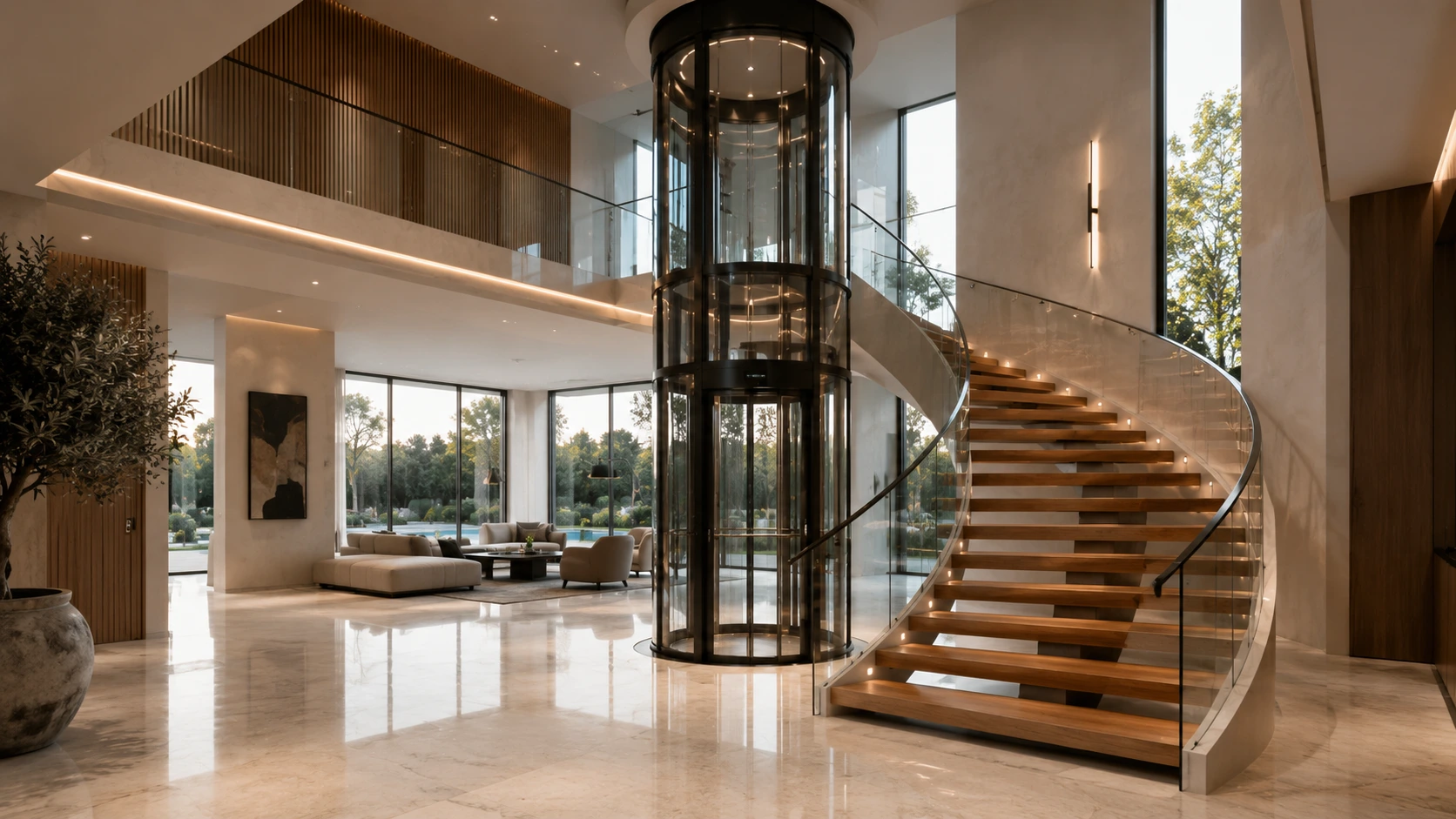
- Vacuum (pneumatic) lifts move the cabin with air pressure inside a transparent tube. Minimal civil work, fast installation, striking looks — and a price band that starts around ₹11 lakh, with tighter capacity limits than conventional lifts.
- Screw-driven systems are common in compact European-style home lifts, trading speed for very small pit and headroom requirements.
None of these is "best." Each is best for a situation, and any supplier who pushes one technology without asking about your building first is selling inventory, not solving your problem.
4. New build vs. retrofit
Installing during construction is almost always cheaper: the shaft is designed in, the structure accommodates it, and nothing gets demolished. Retrofits into existing homes are entirely feasible — self-supporting steel-and-glass shafts exist precisely for this — but the structure adds ₹3.5–7 lakh, and site conditions (foundation access, floor cutting, available headroom) drive the final number. A retrofit quote without a site inspection behind it is a guess.
Civil work: the second budget
Equipment quotes usually exclude the construction the lift sits in. Budget for it separately:
- RCC shaft (new construction): roughly ₹2.5–4.5 lakh for a typical residential travel height
- Self-supporting steel/glass shaft (retrofits, panoramic lifts): ₹3.5–7 lakh
- Pit excavation and waterproofing: ₹30,000–70,000 for the 300–1,000 mm pit most systems need
Waterproofing is not the place to economise. A lift pit is the lowest point of your home, and Bangalore gets monsoons. If your plot has any history of water ingress, get a waterproofing design from your structural engineer, not just a coat of sealant from the contractor.
These figures are illustrative planning estimates — actual civil costs depend on travel height, soil, and structure. Treat them as a starting range for your architect's estimate, not a fixed price.
The costs quotes leave out
This section exists because the gap between "quoted price" and "amount actually paid" is where most budget pain lives.
- GST — 18%, and it's rarely in the quote. Lift supply and installation is taxed at 18% GST, and manufacturers almost universally publish prices exclusive of it. A narrow exception at 12% exists for certain composite works contracts on a single residential unit — the applicable rate depends on how your contract is structured, so ask each supplier to show the GST treatment separately in the written quotation and confirm it with a tax professional. Also worth knowing: homeowners generally cannot claim input tax credit on a lift, since it's treated as part of immovable property.
- Statutory fees and paperwork. Karnataka's approval process (next section) involves modest government fees plus, often, a service charge if your supplier handles the filings.
- Electrical work. A dedicated circuit, possible distribution-board upgrade, and — for larger systems — three-phase supply. Small money individually; surprising when unbudgeted.
- Backup power integration. Most modern lifts include an Automatic Rescue Device (ARD) that lowers the cabin to the nearest floor during an outage — confirm it's in your specification rather than assuming. Full operation during power cuts needs inverter or generator integration, which is a separate line item.
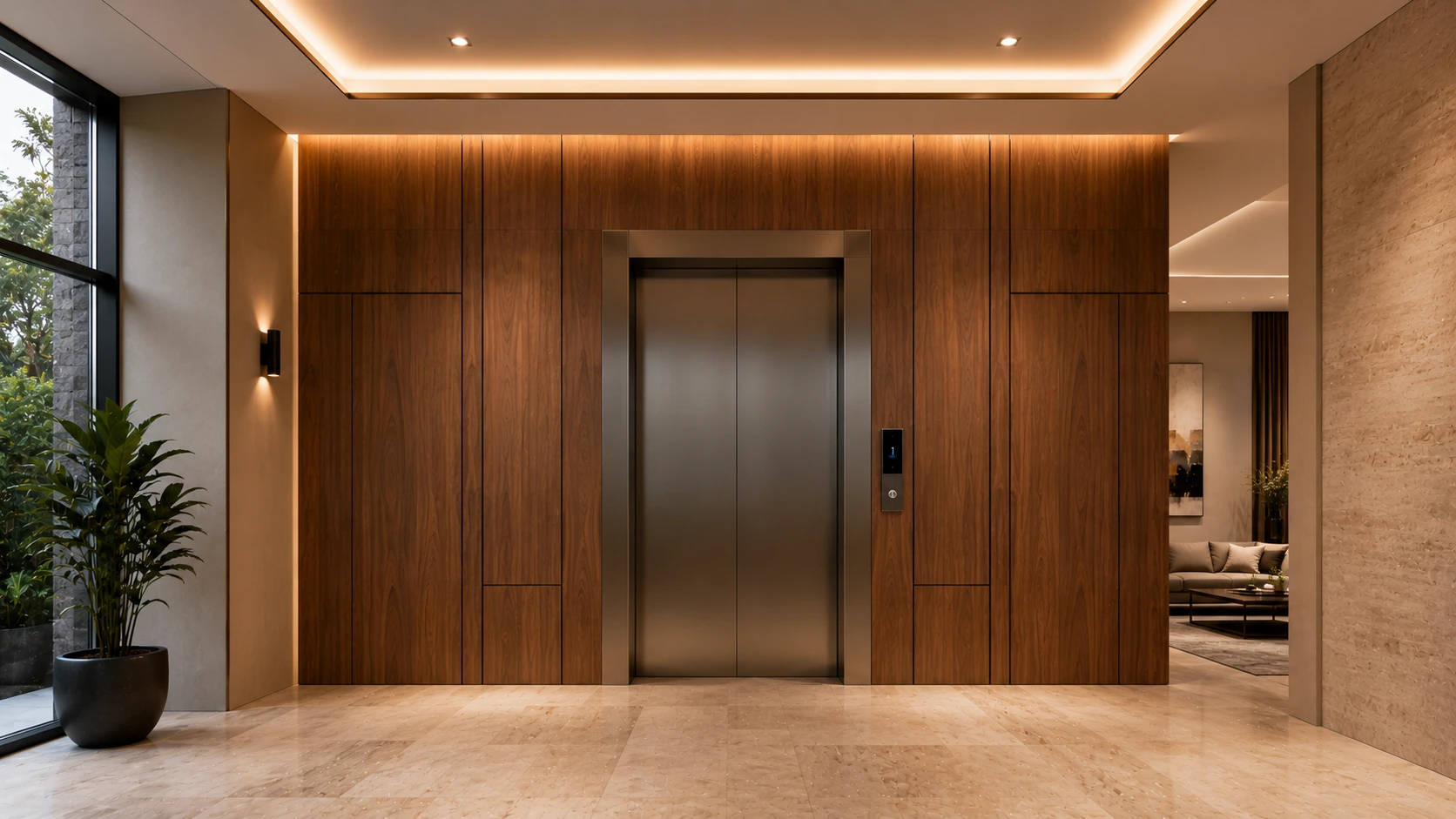
- Landing finishes. Designer landing doors and cladding around the shaft openings sit in neither the lift quote nor the standard civil estimate. Decide early whether they're in your interior budget.
What the law in Karnataka actually requires
This is the part most cost guides get wrong, so we'll be precise.
Under the Karnataka Lifts, Escalators and Passenger Conveyors Act and its Rules, a powered passenger lift in a home is not a plug-and-play appliance:
- Before installation, the owner applies for erection permission in Form A1, with the approved building plan, to the authorised officer under the Act. Permission is valid for one year.
- The lift must be erected and installed by a person registered under the Act with the Chief Inspector of Lifts. Before appointing an installer, ask for their current Karnataka registration details in writing.
- After installation, the owner applies for a licence to use the lift in Form B1, with the erection completion report and manufacturer test certificates. The installation is inspected before the licence is granted. Using the lift without it is an offence.
- Ongoing: maintenance and periodic testing records must be kept.
The Act was amended in 2025 to require installations to conform to current BIS codes and the CEA safety regulations — which leads directly to the next point.
Standards are changing — make suppliers prove compliance
India's lift standards have been consolidating into the IS 17900 series, which aligns Indian requirements with the international ISO 8100 family — the same lineage as Europe's EN 81-20/50 safety standards. Older codes remain in circulation alongside it, and state processes have historically referenced earlier standards, so which codes apply to a given model is a question for your supplier to confirm.
Practical translation for a buyer in 2026: ask every supplier to identify, in writing, the current BIS standards applicable to the quoted model and to provide the compliance documents and test certificates — not "BIS certified" in the abstract.
What it costs to run
Electricity: under normal household use, expect roughly ₹500–1,500 a month, driven by trips per day, travel height, and drive type. Gearless traction systems sit at the lower end; ask the manufacturer for the model's standby and per-trip consumption figures and do the arithmetic against your BESCOM tariff rather than trusting a universal number — including this one.
Annual maintenance (AMC):
- Basic AMC — inspections, lubrication, preventive maintenance, emergency callout: typically ₹25,000–35,000/year
- Comprehensive AMC — the above plus labour and major component replacement: typically ₹40,000–70,000/year
Read the exclusions list before comparing AMC prices. A cheap AMC that excludes the components most likely to fail is not cheap.
Service proximity matters more than it looks on paper. A lift is a 15–20 year relationship with whoever maintains it. A supplier with technicians and spare parts stocked in Bangalore can typically respond far faster than one servicing the city from elsewhere — ask every supplier for their committed response time and where spares are held. When two quotes are within a lakh of each other, the service network is usually the real difference.
Three planning scenarios
Illustrative estimates for orientation — every real project needs a site assessment.
- Duplex retrofit (G+1, existing home). Compact hydraulic or screw-driven lift, self-supporting steel shaft, minor civil work. Plan around ₹11–15 lakh all-in before GST. The variable to watch: structural condition where the shaft lands.
- New G+2/G+3 family villa. Gearless traction or hydraulic lift designed into the build, RCC shaft poured with the structure. Plan around ₹12–20 lakh before GST depending on stops and finishes. Cheapest per-floor outcome of the three, because nothing is retrofitted.
- Premium panoramic installation. Glass cabin, steel-and-glass shaft as an architectural feature, custom finishes, smart controls. ₹25 lakh upward — and at this tier, the design fees and finishes can rival the machinery.
How to compare quotes (the part that saves you money)
Get every supplier to state, in writing:
- Rated load and passenger capacity
- Number of stops and total travel
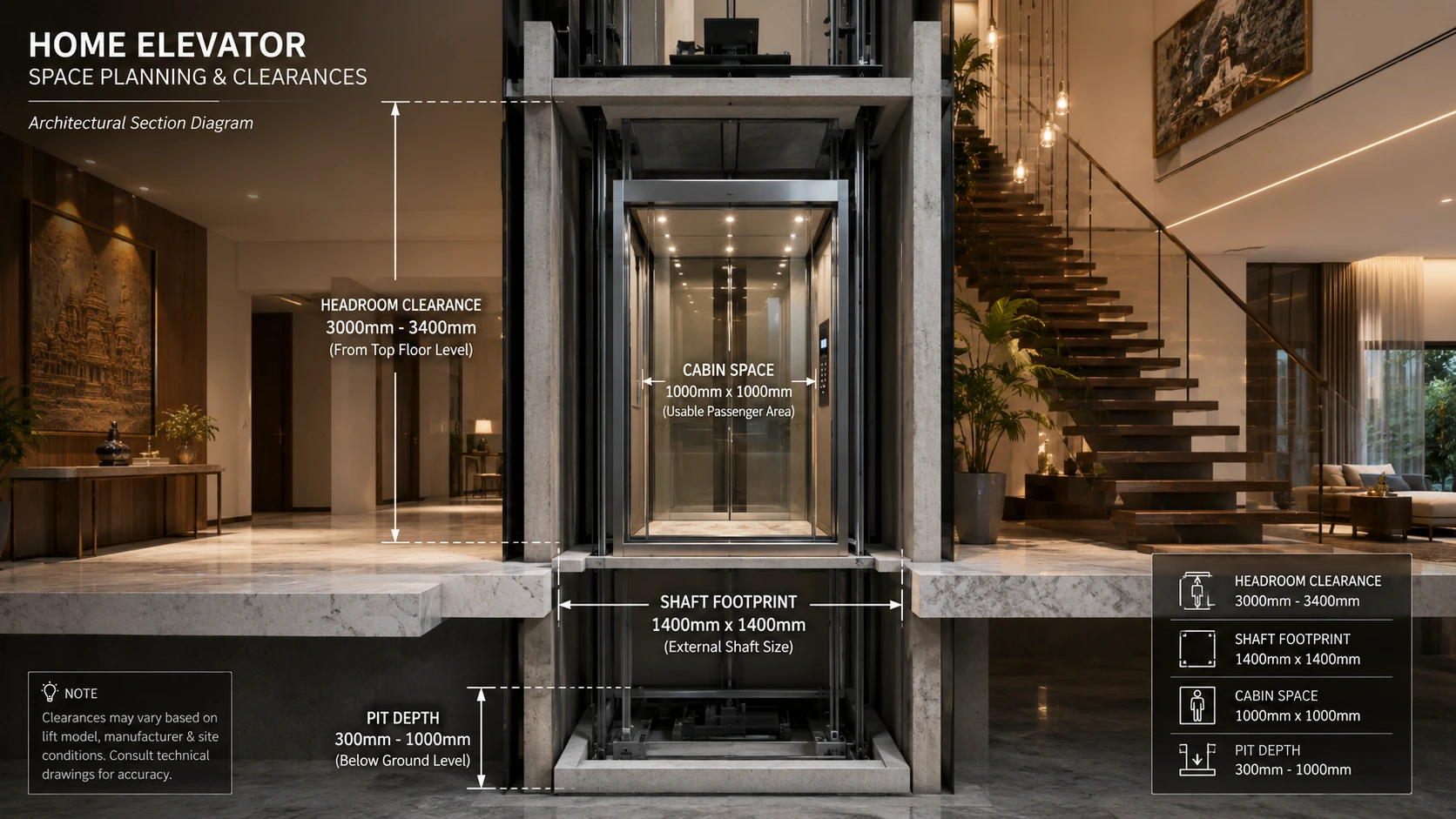
- GA drawing — shaft footprint, pit depth, headroom, clear door width
- Drive technology and motor specification
- What's included: equipment / installation / civil / electrical
- GST treatment, shown on the quote
- ARD included — yes or no
- Applicable current BIS standards for the quoted model, confirmed in writing
- Who files Form A1 and Form B1, and who pays the fees
- Warranty term and AMC pricing with the exclusions list
- Delivery and installation timeline (typical installation: 1–3 weeks after civil work)
- Proof of registration with the Karnataka Chief Inspector of Lifts
Two quotes that both say "₹12 lakh" can differ by ₹4 lakh once you fill in this table. That's not supplier dishonesty so much as the industry's habit of quoting the machine and leaving the project to your imagination.
Frequently Asked Questions
Is ₹8 lakh really enough for a home elevator in Bangalore?
Yes — locally manufactured conventional home lifts start around ₹8 lakh ex-GST for compact G+1 configurations. What matters at any price point is the same: current BIS-standard compliance, a registered installer, and a real service network. Price and safety compliance are separate questions; verify the second regardless of the first.
Do I need government approval for a lift in my own house?
Yes. Karnataka requires erection permission (Form A1) before installation and a licence to use (Form B1) after, and the installer must be registered with the Chief Inspector of Lifts. Reputable suppliers handle this paperwork as part of the project — ask.
Can I add a lift to a house that has no shaft?
Usually, yes. Self-supporting steel-and-glass shaft structures are designed for exactly this, mounted inside a stairwell void or against an external wall. Feasibility depends on structure and space — it's the first thing a site assessment answers.
How much space does a home lift need?
It depends on the model — which is why the honest answer is "ask for the GA drawing" rather than a universal figure. Compact home lifts fit in footprints around a metre square; wheelchair-accessible cabins need meaningfully more, especially clear door width.
How long does installation take?
As a planning guide, residential installations often take one to three weeks after civil work is complete, plus the statutory inspection before the use licence is issued — but timelines vary by model and site, so get the committed schedule in your contract.
What happens during a power cut?
Lifts specified with an Automatic Rescue Device bring the cabin to the nearest landing and open the doors. For continued operation through an outage, you'll need inverter or generator backup sized for the lift.
Does a home lift add resale value?
It can add buyer appeal in the villa segment, particularly for multi-generation households, but there's no reliable data guaranteeing it returns its cost at sale. Treat it as a livability investment first, with any resale benefit as a bonus.
Is a home elevator worth it, or should I consider a stairlift instead?
A stairlift costs a fraction of an elevator and solves single-user mobility on an existing staircase — but it serves one seated person, alters the staircase, and does nothing for luggage, groceries, or the rest of the household. An elevator is whole-home infrastructure. If the need is one elderly family member on one staircase, price a stairlift honestly first; if the whole household will use it daily for decades, the elevator usually justifies itself.
What is the cheapest type of home elevator?
Conventional locally manufactured lifts — typically hydraulic or geared traction in a basic cabin — carry the lowest upfront price, starting around ₹8 lakh ex-GST in Bangalore. "Cheapest to buy" and "cheapest to own" can differ, though: factor in energy use, AMC pricing, and spare-part availability over 15+ years before deciding on the sticker price alone.
How noisy is a home lift?
It varies more by technology than buyers expect. Gearless traction and screw-driven systems are among the quietest; hydraulic pumps make some noise during ascent; vacuum lifts have a pump that runs on every upward trip, which homeowners consistently report as more noticeable than they anticipated — especially near bedrooms. Whatever you choose, ride it at a showroom or demo installation before signing, and think about which rooms adjoin the shaft.
How long does a home elevator last?
Plan for 15–20 years as a working life, with well-maintained systems lasting longer. The bigger variable is the maintenance relationship: a lift serviced regularly by a supplier with local spares typically ages gracefully; a neglected one accumulates small faults that cascade into major component failures.
What are the most common problems with home lifts?
Door faults lead the list by a wide margin in service-call data — misaligned doors, debris in the door sill, and dirty sensors that stop the lift from starting. Leveling errors (the cabin stopping slightly above or below the floor) and dust on sensors are next. Most of these are prevented by routine maintenance, which is the practical argument for a proper AMC rather than pay-per-breakdown servicing.
How often should a home lift be serviced?
Quarterly preventive visits are a sensible baseline for residential use, with dusty construction-heavy neighbourhoods warranting more frequent checks. Karnataka's lift rules also require maintenance and periodic testing records to be kept — so servicing isn't just good practice, it's part of staying compliant.
Can a wheelchair user use a home lift?
Only if the cabin and door are sized for it — and this is where marketing labels mislead. Standard vacuum-lift cabins are circular and too narrow for a wheelchair in any orientation, and a "4-passenger" conventional cabin doesn't automatically have the clear door width a wheelchair needs. If wheelchair access is the point of the project, specify it explicitly and verify dimensions on the GA drawing before anything is ordered.
Do Bangalore's power fluctuations damage home lifts?
Voltage surges are a documented cause of controller and motherboard failures in residential lifts. A dedicated circuit with surge protection — and a voltage stabilizer where the local supply is unstable — is cheap insurance for the most expensive electronic component in the system. Ask your supplier what surge protection is included and what they recommend for your area.
Can I install a lift during monsoon season?
Installation itself isn't season-dependent, but pit waterproofing quality shows up in the first monsoon. Water entering the pit can damage limit switches and electrical components at the lowest point of the system — one more reason waterproofing belongs in the civil scope, done properly, not as an afterthought.
Next steps
If you're at the research stage, the quote-comparison checklist above is the most useful thing to take away — it turns four incomparable quotes into one honest spreadsheet.
If you're further along and want numbers for your specific home: Teknix manufactures home elevators in Bangalore, with systems starting at ₹8 lakh, and offers a no-obligation site assessment covering space, structure, and the Karnataka approval pathway.
Sources
Method: pricing bands are planning ranges compiled July 2026 from published manufacturer price lists (base equipment, applicable taxes excluded) and Teknix project configurations. Civil-work and scenario figures are illustrative planning estimates, not quotations. Regulatory and standards information is homeowner guidance, not legal or tax advice — verify current requirements with the authorised Karnataka authority, your architect, and a tax professional before committing.
- Karnataka Lifts, Escalators and Passenger Conveyors Act, 2012 (as amended 2025) — India Code
- Karnataka Lifts, Escalators and Passenger Conveyors Rules, 2015 (Forms A1, B1, B2) — official Rules PDF
- BIS IS 17900 series records — BIS standards portal
- GST treatment of lift installation: advance rulings under SAC 995466; confirm your contract's treatment with a tax professional.
Found an error or outdated figure? Write to sales@teknixelevators.com — this page is re-verified periodically and the date above reflects the last check.